Indonesia-Korea partnership may be ready October, focuses on industry investment | Sector data
(Insider Stories) — The Indonesia-Korea Comprehensive Economic Partnership Agreement, expected to nearly double the volume of bilateral trade between Indonesia and South Korea to $50 billion in 2015 and increase investments by Korean companies in Indonesia, may be finalized within six months, the industry minister says.
Terms of reference have been finalized for the deal, which the government thinks could increase trade to $100 billion by 2020, and the aim is to have an agreement in place before the APEC 2013 CEO Summit in Bali in October. Industry minister M. S. Hidayat and IK-CEPA negotiating team deputy head Agus Tjahjana spoke to media and The Insider Stories this week following a meeting at Hidayat’s office with Korean Minister of Trade, Industry and Energy Yoon Sang-jick. Their comments on development of industry and potential investments under IK-CEPA are below.
Korean investment has taken off in Indonesia in recent years: Korean firms invested $1.9 billion last year, almost 50% more than in 2011 and accounting for 7.9% of total inbound FDI, placing Korea third on the list of investors after Japan and Singapore.
The Asean-Korea Free Trade Area (AKFTA) increased trade between the region and Korea by 23% in the first year after the trade in goods provision was implemented – a successful agreement with Indonesia could yield a similar trade boost, although the government is more interested in promoting Korean investment in local industry than in increasing the flow of goods and services.
Korean companies are present in a range of sectors in Indonesia, from the timber industry to electronics, and the government is hoping for more Korean investment capital in industries including oil, as well as in MP3EI economic masterplan initiatives that aim to boost growth by building roads and air and sea ports across the country. Asean members along with Japan, China, South Korea, India, Australia, and New Zealand also began negotiations this year on a Regional Comprehensive Economic Partnership (RCEP) that could become the world’s biggest free trade area, while Indonesia has recently softened its stance on the the U.S.-led Trans Pacific Partnership (TPP), and indicated it could be interested in joining after initially showing little interest in the partnership.
Agreement sought before October APEC summit
“The target for CEPA is to be completed before the APEC meeting in Bali. We are assessing it based on their [South Korea’s] investments in Indonesia,” according to Hidayat. “We target completion of the bilateral discussions on IK-CEPA this year, with the aim [of the discussions] to encourage investments,” and increase trade to $50 billion from around $30 billion now.
Tjahjana added that, “We have finalized the Terms of Reference and are preparing a draft concept including for trade of goods and trade of services. The direction is heading towards reduction of tax to 0%. The next step will be the request and offer, after May. The third meeting is at the end of May.”
Korea’s biggest companies to deploy full investment capacity
Hyundai Corp., Samsung Group and LG Electronics Inc. (066570) “will enter [Indonesia],” Hidayat said, possibly this year. He said that Yoon pledged “they want to deploy their full investment capability here,” citing Hankook Tire Co. (000240) as “an example of downstream cooperation [in Indonesia] with Korea that uses rubber to make tyres and exports them to the home country.” PT Hankook Tire Indonesia is building a tyre factory in West Java outside Jakarta with a reported investment of $350 million.
Toll roads key to getting industry moving
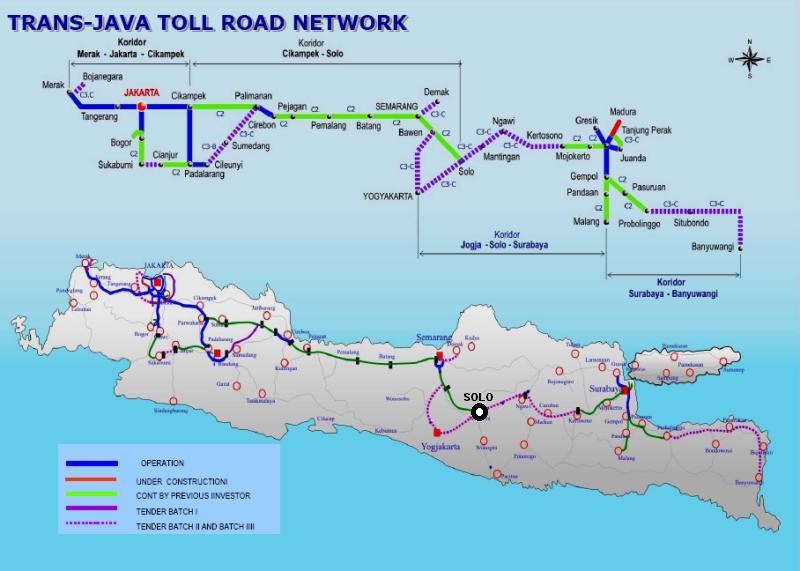
“ [Yoon] agrees with the steps we have taken [in industry], and he said that the first [priority for] development of industry in Korea has been constructing 500 kilometers of toll roads,” Hidayat said. Indonesia is in the process of building a Trans Java Toll Road network stretching around 1,000 kilometers and had planned to complete it next year, although some sections are delayed. Some analysts predict that Indonesia’s current growth rate of above 6% could increase to 8% given better infrastructure, but the country needs to spend $30 billion a year, $20 billion of which is from the private sector, to generate such gains.
Building steel producers to support economy
For IK-CEPA, “the second [priority] is steel, which is the ‘mother industry,’” Hidayat said. Indonesia’s steel consumption rose by more than 30% in 2011 amid strong demand for houses and cars, although consumption last year grew at a much slower 9% to reach 11 million tonnes nationally after the government implemented tougher rules on downpayments for homes and vehicles. There is plenty of room to grow with per-capita steel consumption low at 40 kilograms compared with 120 kilograms in regional neighbours, while incomes are rising and infrastructure programs are set to come onstream, boosting demand. However growth in domestic steel output is less than 5% as most steel is imported from Japan, China and Russia amid a lack of development in the local industry. Only state-owned PT Krakatau Steel produces from iron ore while the other 300 domestic industry players, which employ 500,000 people, use imported scrap. South Korea’s Posco (005490), the world’s number 3 steelmaker, PT Krakatau Steel (KKTS), the biggest integrated steelmaker in Southeast Asia, in 2011 started construction on a joint facility in Banten province that plans to double production to 6 million tonnes of slab, plate and hot-rolled coil when construction of its second phase is complete, scheduled for 2014.
Petrochemicals fuel expansion
“The third industry [to be developed] will be petrochemicals, because of [Korea and Indonesia’s] dependency on imported chemical products. We must support Honam Petrochemical Corp (011170) and PT Pertamina so that the dependencies on petrochemical imports can be erased in the long term. Every year [Indonesia] imports $8 billion in chemical precursors,” Hidayat said. The Indonesian petrochemical industry’s reliance on imported polymers has been increasing as petchem producers from Japan and Taiwan increasingly view the country as an attractive investment destination. The government aims to shift to net petchem exporter status by 2016 with petchem facilities planned by Pertamina and the private sector but many in the industry see this target as optimistic. Still, stagnation in the upstream sector over the last 10 years may be easing. Pertamina has signed MOUs with South Korea’s SK Chemicals Co., Japan’s Mitsubishi Corp. (8058) and Thailand’s PTT Global Chemical Plc (PTTGC) and will likely pick one of them as a partner to build a facility starting next year that will cost $4 billion-$5 billion and produce around one million tonnes a year of ethylene, polypropylene, polyethylene and polyvinyl chloride, while Lotte Chemical Corp. (A011170) and PT Titan Kimia Nusantara plan to spend $3 billion to $4 billion on a facility to produce 1.2 million tonnes of ethylene and prophylene that is expected to be complete by 2018 after an original timeline of 2016 was pushed back. Oil and gas company PT Duta Firza plans to work with LG International Corp. (001120) to build a $3 billion petchem plant in Tangguh, Papua. Honam Petrochemical has also said it plans to invest in Indonesia.
Shipping needed to deliver growth
“The fourth industry is shipping,” according to Hidayat, who said Yoon “recommended that the shipping industry in our archipelago should be strengthened and that Indonesia should set up a large state or privately owned shipping [program] dedicated to achieving this.” Hidayat added, “we cooperate a lot with Korean shipping companies and we have recently bought three submarines from Korea. We want to study from Korea in the [shipbuilding] process so that eventually we can make our own, with shipping industry clusters in Jakarta, Lamongan [regency in East Java], Central Java [province] and Batam [island].” Indonesian shippers operate about 12,000 tugboats, bulk carriers, floating service platforms and tankers, with locally flagged vessels likely to increase by 560 this year, raising industry capacity to 1.2 billion tons of cargo from around 1 billion tons last year. A 2005 cabotage regulation requiring all ships in Indonesian waters to be locally owned, excluding some specialty oil and gas vessels, has seen the local industry nearly double in size. State port operator PT Pelabuhan Indonesia (Pelindo) is expanding ports and shipping facilities are likely to continue to improve under MP3EI. Tonnage at Tanjung Priok port in Jakarta is forecast to rise by around 6% a year over the next three years as the port undergoes a long-awaited upgrade, while container throughput is forecast rising more than 9% over the period amid increasing efficiency. Indonesia has 250 shipyards in Java and outlying provinces but production equipment is outdated and shipyards mostly only build smaller vessels, while shipbuilders rely on imports for two thirds of components like pumps, boilers and electric cables. Domestic shipbuilders produce vessels ranging from 100 deadweight tons coastal cargo ships to 3,000-4,200 DWT inter-island cargo/semi container ships and 50,000 DWT ocean going bulk carriers, while PT Palindo Marine built the country’s first locally produced warship, the 250-ton fast missile boat KRI Clurit (641), in 2011, while South Korea is reportedly set to deliver the three U-209 type submarines, worth $1.07 billion, in 2015 and 2016.