
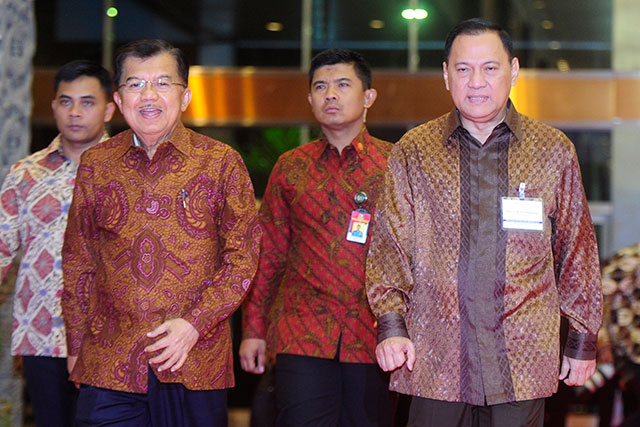
JAKARTA (TheInsiderStories) - Vice President Jusuf Kalla said Bank Indonesia (BI) should stop using the U.S. Federal Reserve as an excuse not to cut interest rates. He said the high bank interest rates is one of four Indonesian weakness in business competition with other countries.
The remarks highlight differing views over rate policy in Indonesia that spilled into public comments this year, with Kalla and other ministers putting varying degrees of pressure on the central bank to cut rates to stimulate a sluggish economy.
“If the interest rate is still high then investment is low. We can not progress if the interest rate is high,” said Kalla in his speech at the Annual Meeting of Bank Indonesia 2015 in Jakarta Convention Center on Tuesday evening.
According to him, to improve the economy in the country, banks also need to lower interest rates for business credit (KUR). With the decrease in the interest rate, the rate of economic growth can be increased.
Kalla explained, to boost investment growth in Indonesia, banks need to provide an attractive offer for businesses such as low interest rates.
“It may happen both, high interest rate and high investment,” said the Vice President.
In addition, Indonesia’s second weakness in economic competition with other countries is the infrastructure facilities and logistics sector.
Government, obviously the Vice President, is currently in the process of building a number of national and regional infrastructure to boost the economy and add jobs.
The third weakness of Indonesia according to him is the bureaucratic process for businesses that are still complicated and expensive.
“Therefore, from some of the policy, there are three policies to speed up this bureaucracy,” said the Vice President.
Next is the competition in the banking sector with other countries, because Indonesia still providing high interest rates for financing and business development.
Meanwhile, the Governor of Bank Indonesia Agus Martowardojo said the central bank will continue to strengthen the mix of its monetary, macroprudential and payment system policies and the circulation of rupiah to maintain Indonesia’s macroeconomic stability, which will eventually contribute to the strengthening of the stability of the country’s financial system.
He elaborated more, such an effort was required to strengthen Indonesia’s resilience and to boost its economic competitiveness in the era of economic integration.
Agus said that in terms of monetary policy, the central bank had been consistent and remained cautious in making policies, which should be in line with its inflation target and could control the current account deficit to a level that was healthy and supportive to overall economic stability.
Agus recognized that the current inflation pressures and account deficit had begun to decline. However, he added that Indonesia should still remain vigilant against external conditions that could potentially destabilize the national economy.
“Including the potential risks that could be triggered by global uncertainty caused by interest rates of the US’ Federal Reserve,” he said.
To increase the resilience of the market, Agus continued, the central bank would also continue its various work programs in order to encourage the foreign exchange market and the money market in Indonesia to become more liquid, in addition to the bank’s effort to encourage the development of derivative instruments for hedging purposes.
In terms of macroprudential policy, Agus said, the central bank would continue to maintain the stability of the financial system. One of these, he said, was to strengthen the macroprudential authority, currently regulated in Law No. 22/2011 on OJK, by accommodating it in the amendment of Law No. 23/1999 on Bank Indonesia.
“We consider it necessary to ensure the implementation of effective macro-prudential oversight functions in the financial sector,” said Agus.
In terms of payment systems and the management of the rupiah, BI policies would be directed to strengthen the payment system so that it could run more safely, smoothly and efficiently.
Agus explained that the rapid use of technology-based payment instruments such as credit and debit cards, electronic money and digital technologies such as internet banking and mobile payment needed to be anticipated in terms of their security and efficiency.
“Therefore one focus of policies that we aim to achieve is to strengthen the security features on card implementation through a 6-digit PIN credit card and also the use of a chip for debit card and ATM,” he said.
BI projected improvement in the domestic economy in 2016 to 5.2 to 5.6 percent.
Agus said it was supported by domestic demand on the investment side considering the unstable global economy significantly.
BI governor also expects credit growth and bank financing in 2016 in the range of 12-14 per cent, supported by third-party funds amounting to 13-15 percent.
Agus said one domestic strength that can make the Indonesian economy remained optimistic in the future are a number of steps taken by the government in 2015 to overcome the structural barriers that became the basic capital of the national economy to be more competitive.