General election will be held in Indonesia on April, 17, 2019. For the first time, the President and members of People’s Con
sultative Assembly will be elected on the same day.
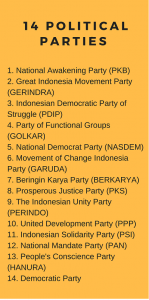 The campaign period is tentatively scheduled to take place from Oct. 18, 2018 to April, 13, 2019. Nine political parties has declared to support Widodo-Amin in the upcoming presidential election while Subianto-Uno get backed up from four parties.
Based on 2014 GEC data, the majority of seats in the House of Representatives is held by PDIP, with 19.4 percent followed by Golkar Party 19.4 percent, Gerindra 13 percent, Demokrta 10.9 percent, PAN 8.6 percent, PKB 8.4 percent, PKS 7.1 percent, PPP 7 percent, Nasdem 6.4 percent and Hanura 2.9 percent.
A recent survey by Saiful Mujani Research Consulting (SMRC) also shows that the Widodo chances of being elected are is still ahead of those of Subianto. Its latest survey placed Widodo’s electability at 53.8 percent and Subianto only marked 18.5 percent.
What is clear is that the political landscape from now until the presidential election could still see a major shift, marked by a looming threat to national security, something that the government and business players need to monitor.
However, Mohamad Sobari, a political observer, said that despite intense political competition, Indonesian society is becoming more mature in general, in regard to political leaders. This was clearly seen in last year’s Jakarta gubernatorial election. Some sections of the society might try to provoke others with race or religious issues; however, the general public responded with a more cautious, matured appraisal.
Although the political tension in Jakarta’s gubernatorial election last year was under control, there is no guarantee that there will be no political and security upheavals in the upcoming regional elections. Therefore, there is a need for the government to take steps to mitigate unrest and social disintegration because democracy has its limits. These include limiting provocations in social media and suppressing any ‘hoax’ news that could spark social unrest.