
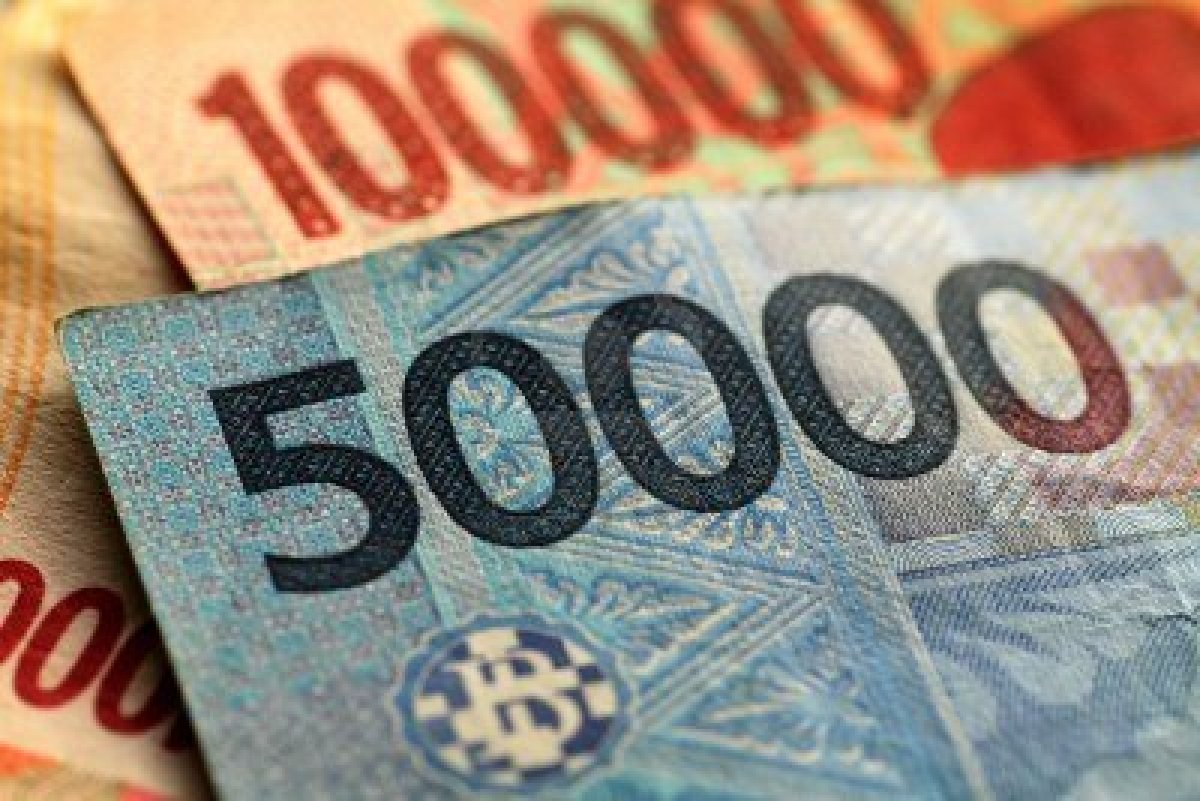
(TIS) – The rupiah is likely to find a new equilibrium around current levels, potentially weakening even further as the central bank takes its hand off the tiller and allows the currency to depreciate, protecting its diminishing foreign-exchange reserves, which fell below $100 billion last month for the first time since February 2011, and allowing market forces to work.
But there are signs Indonesia’s currency – the worst-performing major currency in the region in recent weeks – could be set to pick up again over the coming months, although it may take time to regain the ground lost since late last year.
Bank Indonesia last week released a statement saying that the rupiah is seeking a new equilibrium amid ongoing outflows. The currency suffered its biggest intraday losses in 13 months Tuesday, and this week had its worst week since September 2011, according to data from Bloomberg. It has fallen 4.2% against the dollar in the last three months, Bloomberg data show.
However, some analysts expect Bank Indonesia to continue increasing interest rates after it raised borrowing costs by more than expected at its last two policy meetings – this rate-hike front-loading, and with the government’s increase of subsidized fuel prices in June, are expected to shore up macroeconomic conditions, plugging a gap in the current-account deficit and balance of payments, reducing strain on the budget deficit, and increasing the attractiveness of Indonesian assets at a time of outflows from emerging markets to developed economies as investors look ahead to potential tapering of the U.S. Federal Reserve’s bond-buying program, known as quantitative easing.
Indonesia’s Finance Minister Chatib Basri has also said that inflation is set to peak in July with a smooth passthrough expected of price pressures associated with the the fuel price hike, another indication the rupiah won’t stay this weak for long.
A recent bond auction indicated that outflows may be set to decrease – the government last week sold IDR10.65 trillion of debt, beating its indicative goal of IDR7.5 trillion. While yields were high, the strong demand is an encouraging sign for rupiah-denominated bonds – which have fallen 14% year-to-date, the biggest decline among 10 Asian gauges tracked by HSBC – and is another sign the currency looks set for, if not a turnaround, at least a stem in the downward slide.
Below is a summary of views from Bank Indonesia, Citibank, and Finance Minister Basri.
Bank Indonesia: rupiah seeking a new equilibrium
Rupiah Exchange Rate Still Following Development of Indonesian Economic Fundamentals
Today, Tuesday, July 23, 2013, Rupiah was traded within the range of Rp 10,120 – Rp10,265 and was closed at the rate of Rp10,180 / Rp10,220 per USD. Besides due to USD on-going strengthening, today’s Rupiah weakening was also influenced by large foreign exchange demand by corporate and retail sectors, as well as for the purpose of outgoing repatriation of dividend and investment return. Compared to the position at the beginning of 2013 (year to date), Rupiah has depreciated around 5.71%, which is still in conformity with the depreciation trend of regional currencies.
Bank Indonesia Governor, Agus D.W. Martowardojo stated: “In the last few days, Rupiah has been converging to a new equilibrium level which reflects the Indonesian economic fundamentals. During market hours today, foreign exchange market had increasingly thrived with market mechanism operating in an improved condition.” Related to this situation, Bank Indonesia Governor also convinced the general public and market players alike to remain calm, while emphasizing that Bank Indonesia will continue to conduct a thorough surveillance and guard the stability of Rupiah in accordance to the underlying economic fundamentals, with market mechanism staying [intact.]
Citibank economist Helmi Arman expects more rate hikes, following a 50 bps increase this month – twice the market consensus level. Below is an excerpt from a Citi report earlier this month.
Indonesia Macro Flash: BI Rate Increase +50bps; Further Rise Still Expected
BI rate raised by 50bps to 6.50% — Accordingly, the rate on the overnight deposit facility (FasBI) was also hiked 50bps to 4.75%, higher than our expectation and that of the consensus for a 25bps increase.
Strong BI rate increase likely aimed to give more powerful signal — The higher-than-expected increase follows a $7bn decline in the foreign reserve position to $98.1bn in June. The strong rate hike may help to manage the market’s inflation expectations, which potentially can exacerbate the outflows if not well-anchored. However, it is unclear whether it could go far in reversing foreign fund outflows from the bond market, which have been driven by global fund reallocations.
A further rise in interest rates is still likely, in our view — In today’s monetary policy statement, BI expects the inflation impact of the fuel price hike to still be felt up to August (after peaking in July); thus we think that another hike cannot be ruled out. We think the BI and FasBI rates may be increased by another 25 bps in August, bringing the total rate increase this year to 100bps. As regards to inflation, from an expected 8.2% this year, we see headline inflation reverting towards 4.3% by YE14. However, we expect the policy rates to remain stable next year, in light of the expected stimulus withdrawal in the US.
TIS report: Finance Minister Basri tips inflation to peak in July
Basri on Monday tipped inflation to peak this month after rising “quite substantially” in June and July, as the higher fuel prices reduced fuel consumption.
Meanwhile finance ministry data showed foreign investors added IDR1.24 trillion to their holdings of rupiah-denominated government debt in the July 1-15 period, reversing a net IDR19.98 trillion outflow in June.
Five-year bond yields were at 7.2541% Friday, slightly higher than 7.1430% Thursday but well below their level of 7.68% reached on July 16, the highest since March 2011, according to data from the Indonesia Bond Pricing Agency and Bloomberg.
The rupiah was still weakening, with the U.S. dollar offered at IDR10,214-IDR10,316 Friday, according to Bank Indonesia’s published rates, compared with IDR10,212-IDR10,214 Thursday, and IDR10,120-IDR10,020 a week earlier.
Back to News


Leave e message
0 Comments